Magnesium is often overshadowed by nitrogen, phosphorus, and potassium, but it plays a critical role in cannabis nutrition, plant metabolism, and crop performance. For commercial growers, understanding how magnesium functions in the root zone can help prevent deficiencies, protect plant health, and support more consistent results throughout the production cycle.
In soilless cannabis cultivation, magnesium management is especially important because nutrient availability depends heavily on the growing medium, irrigation water, and fertilizer program. When magnesium is overlooked, plants can quickly show visual symptoms and reduced performance.
What Is Magnesium and Why Is It Important for Cannabis?
Magnesium, identified as Mg, is one of the three secondary macronutrients, alongside calcium and sulfur. The term secondary refers only to the quantity required by plants, not its importance. In cannabis production, an inadequate magnesium supply can be just as limiting as a shortage of primary macronutrients or micronutrients.
Cannabis plants need magnesium to support several essential physiological functions, including:
- Photosynthesis
- Chlorophyll formation
- Enzyme activation
- Protein synthesis
- Energy transfer within the plant
Because magnesium is involved in such foundational processes, even a moderate deficiency can affect plant vigor, canopy quality, and overall crop development.
Magnesium’s Central Role in Photosynthesis
One of magnesium’s most important functions is its place at the center of the chlorophyll molecule. Chlorophyll is what gives cannabis leaves their green color and allows plants to capture light energy for photosynthesis.
Without sufficient magnesium, cannabis plants cannot efficiently convert light into energy. That means less support for active growth, weaker plant development, and lower overall production.
For indoor and greenhouse growers, this matters even more. When lighting, irrigation, and fertility are tightly managed for maximum performance, a magnesium imbalance can become a hidden factor that limits crop potential.
How Magnesium Supports Healthy Cannabis Growth
Beyond photosynthesis, magnesium helps activate many enzymes that regulate normal plant function. These enzymes influence key metabolic activities that contribute to steady vegetative growth and flowering.
In practical terms, adequate magnesium helps support:
- Efficient nutrient use
- Balanced plant metabolism
- Consistent crop growth
- Better response to intensive production inputs
For commercial cannabis growers aiming for ideal crop growth, magnesium should be treated as a core part of the fertility strategy, not an afterthought.
Magnesium Deficiency in Cannabis: Common Symptoms
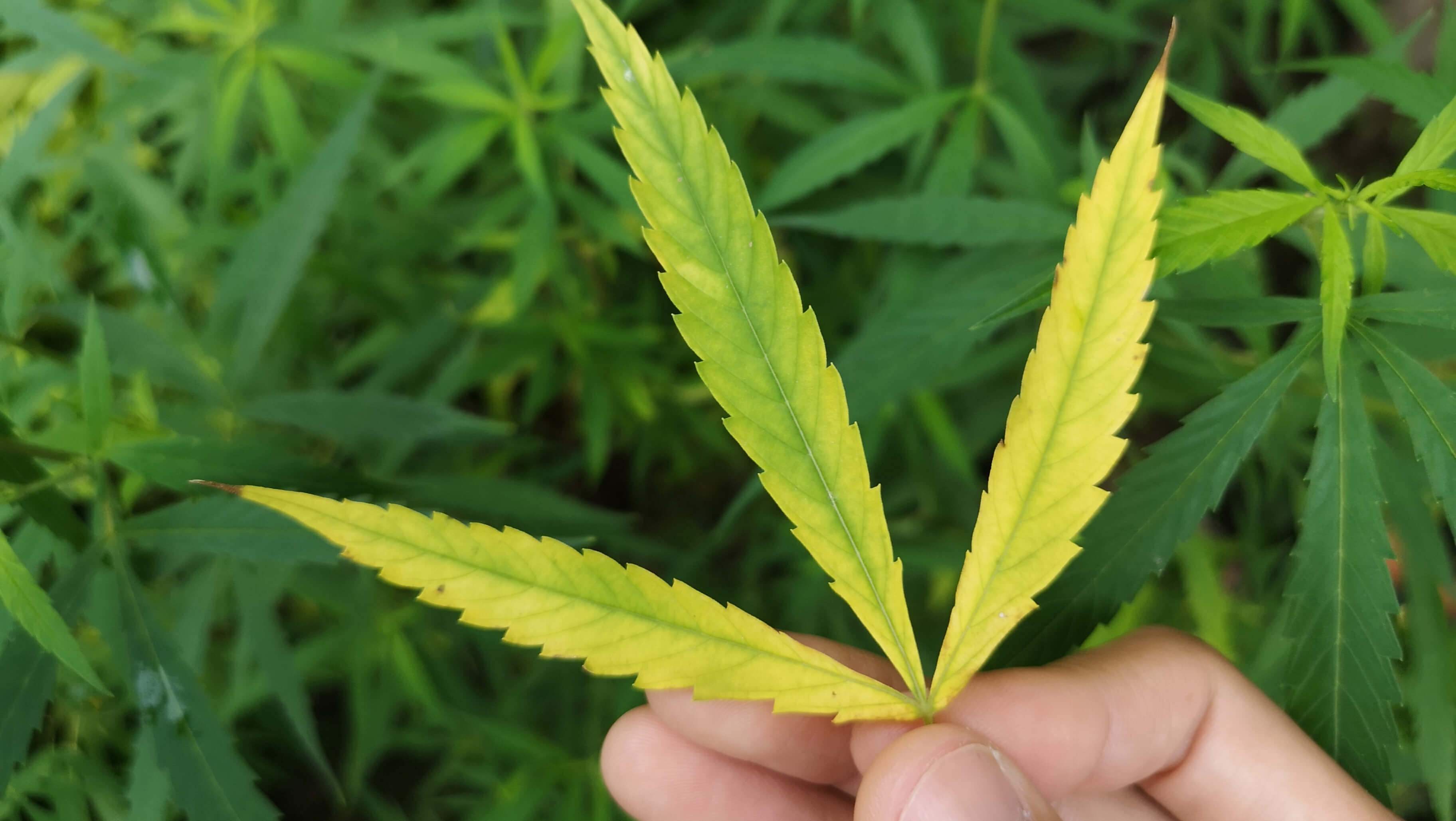
Magnesium is a mobile nutrient inside the plant. When supply is limited, the plant moves magnesium from older leaves to newer growth. As a result, deficiency symptoms usually appear first on older foliage.
Typical magnesium deficiency symptoms in cannabis include:
- Interveinal chlorosis, where tissue between the veins turns yellow while veins remain green
- Yellowing that begins on lower or older leaves
- Gradual decline in leaf function and plant appearance
- Reduced vigor if the issue is not corrected
These symptoms can sometimes be confused with other nutrient imbalances, which is why growers should evaluate their fertigation program and test their water, substrate and plant tissue to verify the problem before making corrections.
What Causes Magnesium Deficiency in Cannabis Crops?
A magnesium deficiency is not always caused by insufficient magnesium in the feeding program. In many cases, the issue is related to nutrient competition due to an imbalanced ratio of nutrients within the root zone.
Common causes include:
1. Insufficient magnesium in the fertilizer program
If your base fertilizer does not provide enough magnesium, plants will not receive what they need to sustain healthy growth through the full crop cycle.
2. Low magnesium in irrigation water
Water can contribute meaningful amounts of magnesium. If your source water is low in magnesium, the fertilizer program must make up the difference.
3. Excess calcium, potassium, or sodium
High levels of calcium, potassium or sodium can compete with magnesium and be taken up by plant roots in place of magnesium, even if its levels are within normal range.
Does pH Affect Magnesium Availability?
In soilless growing media, magnesium availability is not strongly affected by pH, but uptake can improve as substrate pH rises. Even so, pH should be maintained at 5.7-6.2 as this is the ideal range for the availability of all nutrients, including magnesium.
For cannabis growers, the bigger concern is often not pH alone, but how pH interacts with:
- Individual nutrient availability
- Calcium and potassium levels
- Irrigation frequency
- Growing medium composition
A well-managed substrate helps maintain a more stable root zone and supports more predictable nutrient uptake.
Can Cannabis Plants Get Too Much Magnesium?
Magnesium toxicity is uncommon in cannabis production, especially when growers follow a balanced nutrition program. However, excessively high magnesium levels can still create problems.
Too much magnesium may compete with the uptake of:
This can lead to secondary imbalances in plant tissue, even if magnesium itself is not directly causing visible toxicity symptoms. In commercial production, overcorrecting a deficiency can be just as disruptive as underfeeding.
Where Does Magnesium Come from in Soilless Cannabis Production?
Magnesium in cannabis cultivation can come from several sources, including the growing medium, water, and fertilizer.
Dolomitic limestone in growing media
Many soilless mixes include dolomitic limestone, which supplies magnesium and helps adjust pH. However, this magnesium contribution is often not enough on its own to satisfy crop demand through the entire production cycle.
For example, some peat-based cannabis growing media include calcitic and dolomitic limestone as part of the formulation. Even so, growers should not assume the substrate alone will meet magnesium needs throughout the cannabis production cycle.
Irrigation water
Water can supply a useful amount of magnesium, depending on the source. This is why water analysis is so important before building or adjusting a feeding program.
As a general rule, if irrigation water does not provide at least 25 ppm magnesium, growers will likely need to supply additional Mg through fertilizer.
Fertilizers and supplements
Check your fertilizer labels carefully. Some formulations already include magnesium, while others do not. If additional magnesium is needed, common options include:
- Epsom salts or magnesium sulfate heptahydrate
- Cal-Mag fertilizers
- Complete fertilizer programs with built-in magnesium
Each option has different implications for the root zone, substrate pH management and overall nutrient balance.
Epsom Salts vs. Cal-Mag for Cannabis
When magnesium supplementation is needed, growers often compare Epsom salts and Cal-Mag fertilizers.
Epsom salts
Epsom salts supply magnesium in the form of magnesium sulfate. This is a direct and widely used way to increase magnesium in the feed program without adding calcium.
This can be useful when:
- Magnesium is low
- Calcium levels are already sufficient
- You want a targeted correction
Cal-Mag fertilizers
Cal-Mag products provide both calcium and magnesium, which can be helpful in some feeding programs. However, they may be potentially basic, meaning they can gradually raise substrate pH over time.
This can be useful when:
- Extra calcium and magnesium are needed
- Source water is low in both elements
The best choice depends on your water analysis, crop stage, and existing nutrient ratios.
Magnesium Management Tips for Commercial Cannabis Growers
To reduce the risk of magnesium-related issues, commercial growers should take a proactive approach.
Best practices include:
- Test irrigation water regularly
- Review fertilizer labels for magnesium content
- Monitor leaf symptoms early, especially on older leaves
- Watch calcium, potassium, and sodium levels
- Track substrate pH and EC consistently
- Avoid making nutrient corrections without confirmation through testing
- Choose a growing medium that supports ideal root growth.
In cannabis cultivation, nutrient management is never just about one element. Magnesium works within a larger system, and success depends on balance.
Why the Growing Medium Still Matters
Even with a strong fertigation program, the growing medium remains the foundation of root zone performance. A well-designed cannabis substrate can support oxygen flow, moisture management, and nutrient access, all of which influence how efficiently plants use magnesium and other inputs.
PRO-MIX® cannabis growing media are designed to help commercial growers create more predictable root zone conditions. Depending on the formulation, growers can choose peat-based, coco-based, or high-porosity options tailored to their irrigation strategy, environmental conditions, and production goals.
Products enhanced with AGTIV REACH® also support stronger root development and improved nutrient and water uptake through mycorrhizae, which can contribute to better overall crop performance in demanding cultivation environments.
Final Thoughts on Magnesium in Cannabis Production
Magnesium may be classified as a secondary nutrient, but its impact on cannabis performance is anything but secondary. From chlorophyll formation to enzyme activity, magnesium supports many of the processes that drive healthy, productive plants.
For commercial cannabis growers, the key is to treat magnesium as part of a complete root zone management strategy. By combining water inputs, balanced fertility, and a reliable growing medium, growers can reduce deficiency risks and maintain more consistent crop performance from propagation through harvest.