Growing Media Compaction in Cannabis: Causes, Risks and Prevention

How Growing Media Compaction Affects Cannabis Crops
Healthy cannabis crops begin in the root zone. While growers often focus on lighting, fertility, and irrigation strategy, the physical structure of the growing medium is just as important to overall crop performance. When that structure is altered by compaction, the root environment can quickly become less efficient and harder to manage.
Growing media are designed to perform four essential functions: support the plant, retain water, hold nutrients, and allow gas exchange. When these functions are balanced, the substrate helps create a stable environment for root development, irrigation control, and uniform plant growth. When compaction occurs, however, that balance can be disrupted.
In cannabis cultivation, compaction can contribute to reduced aeration, poor drainage, slower dry-back, anemic or uneven root development, and variability across the crop. Understanding what causes compaction—and how to avoid it—can help growers maintain a more consistent root-zone environment from propagation to harvest.
What Is Growing Media Compaction?
Growing media compaction happens when pressure reduces the volume of the substrate and compresses the pore spaces inside the container. This pressure may come from substrate handling, stacked prefilled pots, aggressive filling methods, forceful irrigation, or the weight of the media itself once saturated.
As compaction increases, the structure of the growing medium changes. Larger pores, often called macropores, are especially important because they support:
- air movement through the root zone
- rapid water infiltration
- effective drainage
When these pores collapse, the substrate retains less air and becomes slower to drain. For cannabis growers, this can make irrigation management less predictable and reduce the overall quality of the root environment.
Why Compaction Matters in Cannabis Cultivation
Cannabis roots perform best in a growing medium that provides a reliable balance of oxygen and moisture. Many cannabis-specific substrates are chosen for their ability to deliver strong drainage, high porosity, and watering flexibility throughout the crop cycle.
Compaction interferes with these physical properties and can lead to several production issues, including:
- increased bulk density, which makes containers heavier
- reduced total porosity and air space
- lower gas exchange around the roots
- slower infiltration and increased runoff
- poor drainage and a higher risk of waterlogging
- longer dry-back periods
- less efficient nutrient and water uptake
- greater risk of salt buildup and elevated EC
- restricted root penetration
- uneven root distribution inside the pot
- less uniform plant growth
In practice, growers may notice slower establishment after transplant, inconsistent response to irrigation, or plants that vary in size and vigor across the room.
The Impact on Root Development
Strong root development depends on a substrate that allows roots to expand freely while maintaining access to both water and oxygen. When the medium becomes compacted, roots must work harder to move through it and to reach available moisture.
Instead of growing uniformly within the growing medium, roots may stay concentrated in only certain sections of the pot. This can create uneven water extraction patterns, reduce feeding efficiency, and limit overall plant performance.
Compaction can also make the root zone less favorable for beneficial biological activity. Mycorrhizal inoculants, such as AGTIV REACH® perform best when the growing medium maintains proper structure, air space, and moisture balance. By preserving those physical properties, growers can support active roots, more efficient water and nutrient uptake, and better overall root-zone performance.
Common Causes of Growing Media Compaction
Compaction often develops through everyday production practices rather than one single event. Some of the most common causes include:
Stacking prefilled pots
When filled containers are nested tightly on top of one another, the pots at the bottom carry the weight of the stack. This can compress the media before transplanting even begins.
Excessive handling
Repeated movement of filled containers or rough handling during potting can reduce pore space and increase substrate density.
Overmixing or overfluffing
Processing media too aggressively or too long can break down peat and other aggregates into finer particles. This reduces porosity, affects drainage, and can slow dry-back.
High-pressure watering
Water applied with excessive force can compact the media surface and alter infiltration behavior.
Poor particle distribution
A substrate with an improper balance of coarse and fine particles may be more likely to settle and compact over time.
How to Prevent Growing Media Compaction
Preventing compaction is much easier than correcting it. Once the physical structure of the medium has been compressed, it is difficult to restore its original properties.
To reduce the risk, growers can adopt a few practical handling habits:
- fill containers by gravity rather than packing the media
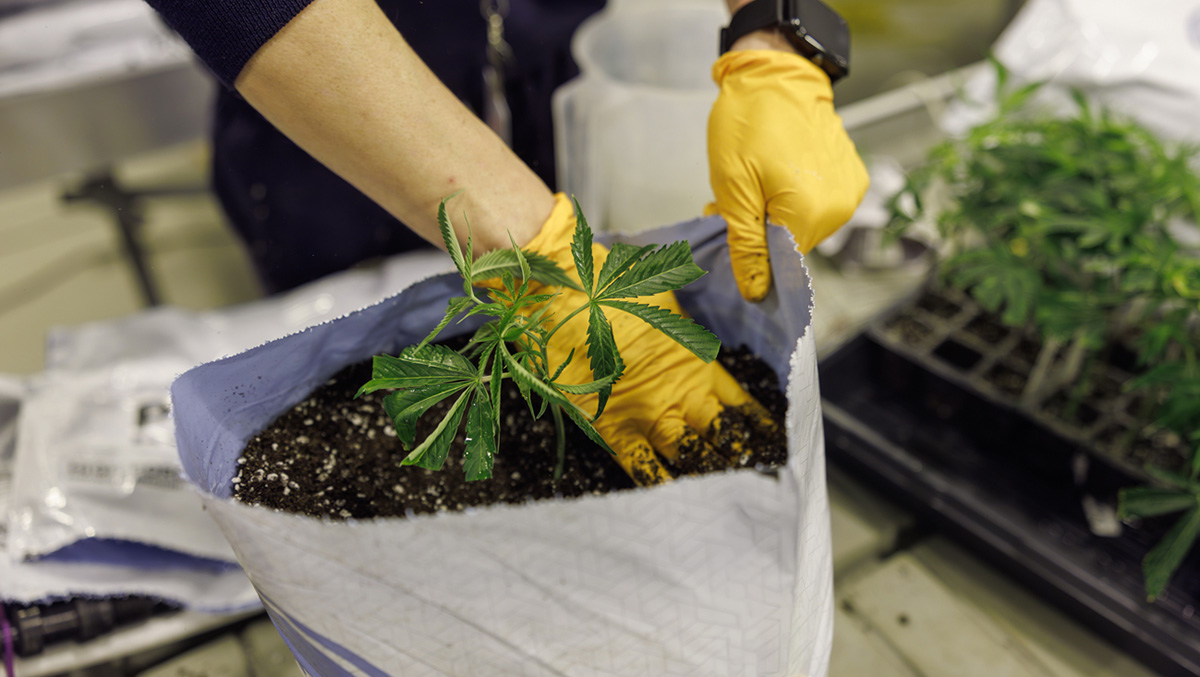
- avoid pressing the growing medium around plugs or cuttings
- water in transplants instead of firming the substrate manually
- minimize unnecessary handling of filled pots and trays
- avoid stacking prefilled containers without separation
- offset stacked pots so they do not nest inside each other
- use slow-turning ribbons or paddles when mixing media
- keep mixing time as short as practical
- add only moderate moisture when fluffing media
- avoid watering with excessive water pressure
These steps can help preserve pore structure, improve irrigation consistency, and support more uniform root development throughout the crop.
Why Substrate Structure Deserves More Attention
In cannabis cultivation, the physical properties of the growing medium have a direct effect on crop consistency. Even when fertility and irrigation programs are well managed, a compacted substrate can still create root-zone limitations that reduce performance.
That is why substrate handling should be viewed as part of the cultivation strategy, not just a preparation step. Protecting the structure of the media helps preserve the drainage, aeration, and moisture balance needed for healthy roots and more predictable results.
Final Thoughts
Growing media compaction can quietly reduce the performance of an otherwise well-designed cannabis production system. By limiting air space, slowing drainage, and restricting root development, it creates challenges that affect both crop uniformity and plant vigor.
The good news is that many of the causes are preventable. With better filling, stacking, mixing, and irrigation practices, growers can protect substrate structure and maintain a more effective root-zone environment from start to finish.
When the physical properties of the growing medium are preserved, cannabis plants are better positioned to develop strong roots, respond more consistently to irrigation, and perform more uniformly across the crop.
Quick FAQ: Growing Media Compaction
It’s when the substrate gets compressed and loses pore space, reducing aeration, drainage, and water movement in the root zone.
Compaction can lead to slower dry-back, reduced oxygen around roots, uneven root development, and less uniform plant growth.
The most common causes are:
- stacking prefilled pots too tightly
- rough handling of filled containers
- packing media during transplanting
- overmixing or overfluffing
- high-pressure watering
Look for:
- pots staying wet too long
- inconsistent irrigation response
- Uneven drying from one container to the next
- runoff issues
- patchy root development
- uneven plant size or vigor
Not easily. Prevention is the best approach: fill lightly, avoid pressing the media, handle containers gently, and water with moderate pressure.
Yes. When structure is preserved, the growing medium is better able to support healthy roots, efficient water and nutrient uptake, and more consistent crop performance.